The Próspera project in Honduras survives solely due to the protection afforded by international arbitration and the state’s current inability to dismantle it.
The so-called „free“ Próspera project in Honduras persists only because of the protection of international arbitration and the state’s temporary inability to eliminate the initiative. This experiment—a „private city“ located on the Honduran island of Roatán—has succeeded, to an extent, in establishing a functional tax and regulatory enclave for global capital in the technology and biotechnology sectors. However, when viewed through the lens of long-term sustainability and genuine individual liberty, the project has run up against the harsh constraints of political reality.
As recently as 2020, the Próspera initiative on the Caribbean island of Roatán generated high expectations. Based on the „Free Private Cities“ concept developed by German lawyer and entrepreneur Titus Gebel, the project promised a revolution: a city operated by a private firm through voluntary contracts with its residents, free from the bureaucratic harassment and inefficiencies typical of a conventional state.
Yet, looking at the reality in 2026, the picture is far more sobering. Rather than a vibrant, autonomous city, what has emerged on Roatán is primarily a highly specialized corporate incubator and tax domicile—an entity whose continued existence rests not on an irrevocable legal right, but on protracted international arbitration proceedings. From Promising
Experiment to Legal Trench Warfare
The legal foundation of Próspera was based from the outset on Honduras’s ZEDE (Zones for Employment and Economic Development) law, which allowed for the designation of territories with broad autonomy. However, this foundation proved to be fatally fragile.
In April 2022, the Honduran parliament, under the leadership of leftist President Xiomara Castro, unanimously repealed the ZEDE law. In September 2024, the country’s Supreme Court declared the entire framework for these zones unconstitutional—with retroactive effect. The project’s operator, the American corporation Honduras Próspera Inc., rejects these actions, citing a 50-year guarantee of legal stability and the CAFTA-DR international trade agreement.
The result is one of the largest international arbitration cases in recent years, currently before the World Bank’s tribunal (ICSID). The investors initially sought an astronomical sum in damages exceeding $10.7 billion (nearly a third of Honduras’s annual GDP); they later adjusted their claim to prioritize the restoration of their rights, with a fallback request for $1.63 billion in compensation.
Although the inauguration of pro-business President Nasry Asfura in January 2026—and Honduras’s subsequent return to the ICSID system—led to a certain political thaw, the project effectively exists in a legal vacuum, protected only by the threat of a penalty that would be financially ruinous for the Honduran state budget. A Tax and Regulatory Haven for the Privileged
Despite political uncertainty, it cannot be said that Próspera has failed entirely. In fact, it functions surprisingly effectively as a regulatory sandbox. Honduran commercial, labor, and tax laws do not apply within the zone (the state has retained only criminal law and the constitutional framework). Companies can choose a regulatory regime from over thirty developed nations and resolve disputes through private arbitration.
For entrepreneurs, this translates into a significant reduction in bureaucratic and tax burdens:
• Company incorporation can be completed online within 24 hours, with fees starting at $280.
• The corporate income tax is effectively just 1% of gross income, while the tax for individuals is 5% (or a flat fee of $5,000 per year for digital nomads).
• There are zero taxes on dividends, capital gains, or assets.
Under these conditions, roughly 250 to 400 companies have established tax residency in Próspera (though most operate only virtually via an „e-residency“ program costing $130 per year).
Only a few dozen companies have a physical presence on the island, primarily in the cryptocurrency and biotechnology sectors—for instance, clinics offering gene therapies that would otherwise face protracted regulatory hurdles from the FDA in the United States. The permanent population within the zone, however, hovers at only around two hundred residents.
An end to coercion, or merely a change of masters?
If we evaluate Próspera by the standard of true freedom—defined as the absence of institutional or interpersonal coercion—the results are highly ambiguous. While the project has significantly curtailed the tax and bureaucratic coercion imposed by the Honduran state, it has not eliminated the principle of coercion itself.
Instead, the authority to levy fees and enforce rules has simply shifted from state officials in the capital, Tegucigalpa, to the management of a private corporation registered in Delaware, USA.
Residents and businesses within the zone are subject to strict building codes, mandatory insurance, and private security forces; furthermore, these rules are not established by the citizens themselves, but by a board of directors appointed by investors.
Moreover, the project has failed to foster a conflict-free environment among neighbors. Residents of the nearby indigenous village of Crawfish Rock have long protested against the zone, citing concerns over potential future land expropriation—which was provided for in the original ZEDE legislation—as well as disputes regarding groundwater resources.
________________________________________
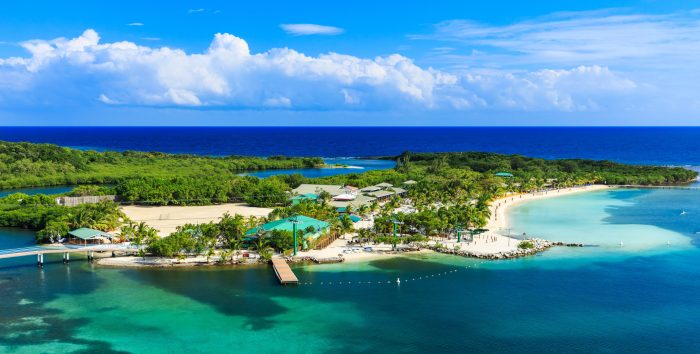
TROPICAL LIFE ON “FREE” ROATÁN:
Roatán experiences tropical nights year-round (with temperatures rarely dropping below 20°C). Combined with high humidity, this makes air conditioning practically essential for maintaining a standard of comfort typical for Westerners.
It is interesting to note how this climatic factor directly intersects with the island’s economic and infrastructural reality—a detail that proves highly revealing for your analysis of the Próspera project:
- Exorbitant electricity costs: Roatán is not connected to the Honduran mainland power grid. Electricity is generated locally—primarily using imported fuel oil and diesel—by a private monopoly, the Roatan Electric Company (RECO). This makes it some of the most expensive electricity in the Americas, with prices typically ranging from $0.40 to $0.50 per kWh—roughly triple the cost in the United States and significantly higher than in Europe.
- The necessity of air conditioning and dehumidification: With relative humidity hovering around 80% and nighttime temperatures between 23°C and 26°C, air conditioning is required not only for cooling but also to prevent mold growth in buildings and protect electronic equipment. Consequently, running air conditioning continuously results in monthly utility bills amounting to hundreds of dollars, even for a small apartment.
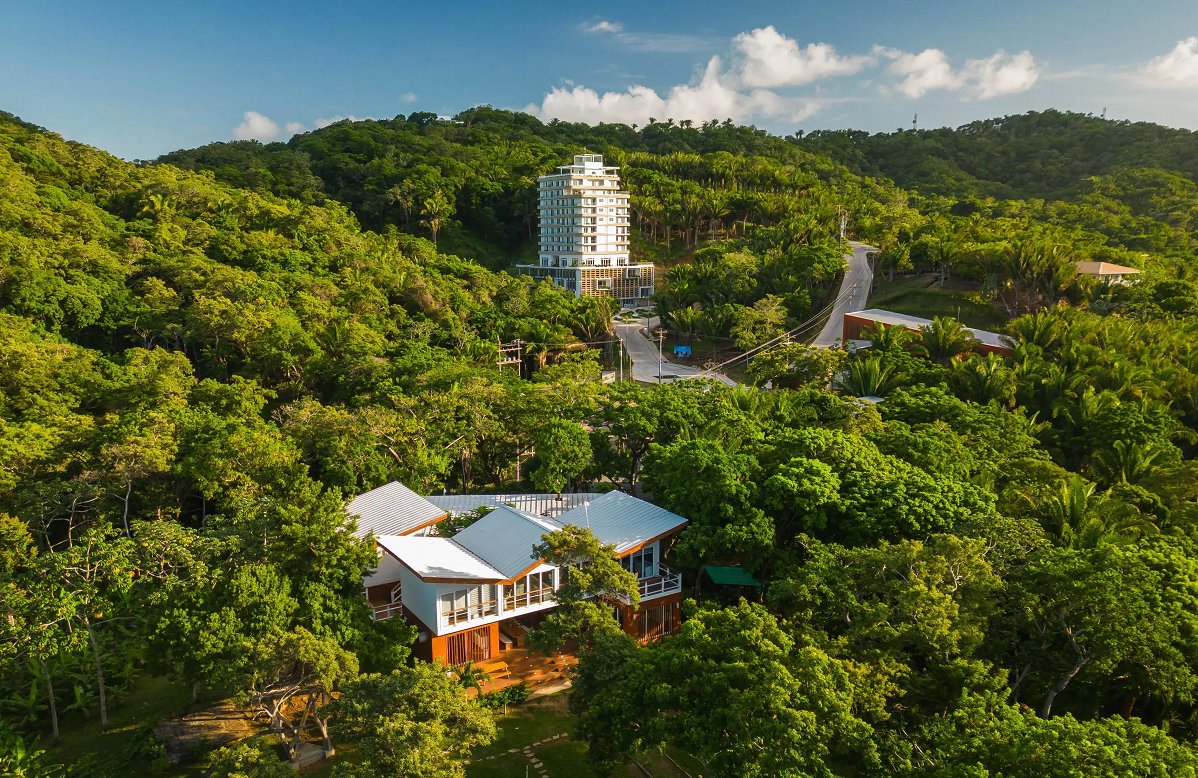
- Impact on the zone’s social profile: The costs of energy and cooling in a tropical climate are yet another reason why living in Próspera’s modern glass-and-concrete buildings (such as the Duna Tower) is not economically accessible to ordinary residents, but rather only to a wealthy clientele. (While Próspera is developing its own solar and battery-based microgrids to reduce reliance on the expensive island-wide grid, the overall energy demand of living in the tropics remains high.)
A Conceptual Flaw: Freedom via a State-Granted License
The story of Próspera reveals a fundamental theoretical flaw in Gebel’s concept of „Free Private Cities.“ The founders believed that an enclave of freedom could be built from the top down—by means of a legislative exemption granted by a corrupt state apparatus (the administration of former President Juan Orlando Hernández, who championed these zones, was later convicted of narco-terrorism in the United States).
It has become clear that sovereignty cannot be credibly „leased“ from a state. What one government grants by law, a subsequent government can take away by law. A truly free community cannot rely on a monopolistic state—which retains control over the police, the military, and the surrounding territory—to act as its guarantor.
A Business Product with a Libertarian Label
Looking at the project’s pricing policy and target demographic, it is evident that Próspera was never intended as a haven for ordinary citizens seeking a life of freedom. An ordinary working person will find neither affordable housing nor public amenities here. It is a premium business product (“Governance-as-a-Service”) targeting venture capital, crypto-entrepreneurs, and the global elite.
The rhetoric surrounding a “private city” and individual liberty served primarily as a brilliant marketing label, attracting the attention of both the media and ideologically aligned investors from Silicon Valley.
If the international arbitration ultimately results in a financial settlement—paid for by impoverished Honduran taxpayers—then the investors behind Honduras Próspera Inc. will have successfully monetized their business venture, regardless of the fact that no truly free city was ever established on Roatán.

Divided Sovereignty and the Trade in Rules in Practice
To understand why Próspera attracts the attention of investors from Silicon Valley, we must look beneath the surface of its unique legal arrangement. The zone does not operate in a legal vacuum; rather, it functions under a system of „divided jurisdiction.“ While the Honduran state has retained a monopoly on criminal law within the zone—meaning that crimes such as murder, theft, or serious fraud continue to be investigated by the national police and adjudicated by the regular court system—a completely autonomous sphere has emerged regarding civil, commercial, and labor law.
Companies registered within the ePróspera system are not subject to local bureaucracy. Instead, they can essentially „choose“ their regulatory framework from a selection of over thirty developed nations—for instance, adopting the well-established commercial law of the U.S. state of Delaware.
The way financial flows are structured within the zone also warrants special attention. This is not a „zero-tax“ haven, but rather a highly efficient commercial model. From the taxes collected—specifically a one-percent levy on corporate gross revenue, a five-percent personal income tax, and a 2.5-percent sales tax—the operator remits approximately twelve percent directly to the central government of Honduras, serving as a form of „rent“ for the autonomy granted. The remaining eighty-eight percent stays within Próspera’s own budget, funding local infrastructure, private security, and—not least—the profits of the American parent corporation.
In practice, this has not created a lawless society on Roatán, but rather a regulated marketplace where entrepreneurs purchase legal certainty and expedited administrative processes as a standard commercial service. In the biotechnology sector, for instance, this allows for clinical trials of gene therapies to be conducted within months, rather than waiting years for approvals from the U.S. Food and Drug Administration (FDA).
It is this speed—rather than an ideological zeal for freedom—that serves as the primary driver for companies linked to tech giants to establish subsidiaries within the zone.
Roatán versus the mainland: A departure from the original vision of „free private cities“
An interesting comparison emerges when examining how Próspera itself has diverged from the original theory proposed by its intellectual architect, Titus Gebel. A German lawyer who served as Chief Legal Officer for the project between 2017 and 2019, Gebel conceived of „Free Private Cities“ as full-fledged urban centers for ordinary citizens, where the contractual relationship between the operator and the resident replaces the traditional social contract with the state.
On Roatán, however, this concept has gradually evolved into an exclusive, architecturally ostentatious campus—one where real estate prices and the cost of living are far beyond the reach of the middle class, let alone the local population. The fact that Gebel’s concept could take a completely different form in practice is demonstrated by a second, far less publicized Honduran project—also based on the ZEDE (Zones for Employment and Economic Development) law—known as Ciudad Morazán, located on the mainland near the industrial hub of Choloma.
While Próspera targets crypto-millionaires, digital nomads, and biotech laboratories within a Caribbean resort setting, Ciudad Morazán was established to provide affordable, secure housing for ordinary Honduran workers and their families—people otherwise plagued by pervasive street crime and gang violence.
It is precisely this contrast that starkly exposes the weakness of the Roatán experiment. On the mainland, a private zone sought to address the most pressing concerns of ordinary people—namely, basic physical safety and affordable housing—whereas Próspera, on Roatán, opted instead for the glitz and glamour of global capital.
In doing so, however, it forfeited the natural support of the local population, for whom it remained nothing more than an alien, luxury enclave—fenced off by a barbed wire of legal exemptions.