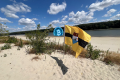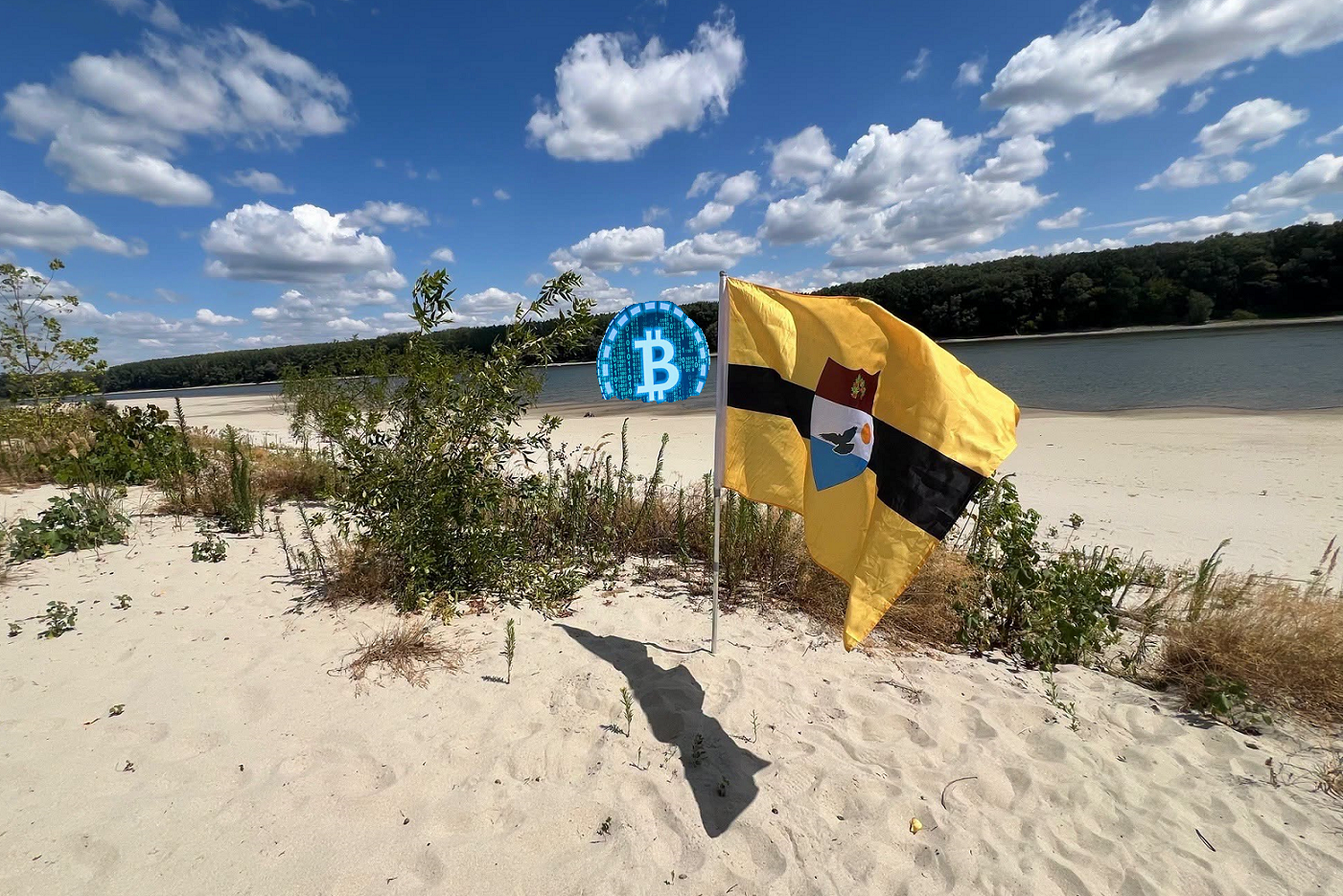
Liberland: A guerrilla attempt to seize territory has failed. All that remains is an online shop selling virtual illusions. (Illustrative photo: editorial collage).
The „Free“ project known as Liberland has failed completely to live up to the promise of its name (a compound of „Liberty“ and „land“), as it has provided its supporters with neither freedom nor an autonomous (free) territory. What began as an unsuccessful attempt to squat on a supposed „no man’s land“ has ultimately devolved into a business built on digital illusions—somewhere between a virtual happening and an esoteric travel agency.
In April 2015, when Czech activist Vít Jedlička planted a flag in a muddy floodplain on the west bank of the Danube and proclaimed the „Free Republic of Liberland,“ he managed to spark cautious interest from some media outlets. He promised a libertarian paradise featuring voluntary taxation, a minimal state, and the motto: „Live and let live.“
Yet, more than eleven years later, a sober look at this experiment reveals a harsh reality. Liberland has not become a laboratory for genuine freedom; rather, it serves as a textbook example of a guerrilla marketing stunt—one that has arguably discredited the very concept of a free society in the public eye, rather than advancing or realizing it.
From a Danube Swamp to a Virtual Pseudo-State
The foundational premise behind the creation of Liberland rested on a legal loophole. Jedlička set his sights on a parcel of land known as Gornja Siga—an area of roughly seven square kilometers situated between Croatia and Serbia.
Due to historical disputes over border demarcation following the breakup of Yugoslavia, neither of the neighboring states formally laid claim to this particular strip of land.
The founders of Liberland characterized this situation as *terra nullius*—no man’s land—appropriated the territory in question, and declared it their own new sovereign state.
It must be noted at this point that seizing „ownerless“ land within a world dominated by the state is a rather peculiar way to build a freer society. It is reminiscent of the statist approach of a traditional state, whose primary *modus operandi* involves the acquisition and exaction of others‘ property under the threat of force…
Did the standard-bearers of Liberland truly believe it was possible to acquire territory—that is, land—for free? This concept is a blend of utopia and communist dystopia.
The project’s evolution over the past decade has revealed a vast chasm between digital ambitions and physical reality:
Physical blockade: From the very outset, Croatian authorities have rejected the existence of a new „State of Liberland,“ as they effectively administer and guard the territory in question. Attempts at settlement have been met with interventions by the Croatian police—including arrests and the clearing of makeshift camps—as occurred, for instance, in 2023.
As late as September 2026, some sensationalist media outlets reported that the Croatian river police had stopped a boat carrying the „President“ himself, Jedlička, just thirty meters from the shore, preventing him from setting foot on the territory of his „own republic.“
A retreat into the digital realm, a computer-game simulation of freedom: Given the impossibility of establishing functional infrastructure at Gornja Siga, the project’s leadership shifted its operations to the internet and to neighboring Serbia.
A base of operations dubbed „ARK Village“was established in the Serbian town of Apatin, serving as a venue for conferences and festivals, while the „state“ itself transformed into a Decentralized Autonomous Organization (DAO) running on its own blockchain.
In other words, rather than realizing the ambition of creating a genuine, autonomous society, Liberland has morphed into a kind of „online association“—one governed not by the foundational principles of a free society or the spontaneous interactions of its inhabitants, but by a computer program…
In practice, this means that Liberland currently functions much like an exclusive online gaming clan or an investment club. Participants use real money to purchase virtual tokens from the organizers; they then use these tokens to vote on virtual laws via the internet and track their entries within a database.
Everything „functions“ – seemingly without a hitch – on a computer screen. However, outside the internet, that is, on the actual physical territory by the Danube, these activities carry no legal weight or relevance whatsoever.
A numbers game: Official statistics from Liberland, dating from the autumn of 2026, cite over 815,000 applicants for citizenship; in reality, however, there are only a few thousand registered citizens and e-residents (with full-fledged citizens numbering roughly 1,300).
Cryptocurrency entrepreneur Justin Sun has been repeatedly elected to lead the government, and for 2026, the project’s leadership announced ambitious investment plans—amounting to tens of millions of dollars—for the broader Baranja region.
Yet, despite the persistent and highly costly efforts of its leaders, Liberland has failed to secure diplomatic recognition from any sovereign state.
Cryptocurrency Plutocracy
By 2026, Liberland’s politics had devolved into an overt plutocracy, where political influence is literally purchased with cryptocurrency. At the helm of the government sits Chinese crypto-billionaire Justin Sun, serving as Prime Minister; the weight of each “citizen’s” vote in digital ballots depends directly on how many “Liberland Merit” virtual tokens they have purchased.
Although the project’s leadership announced an ambitious 40-million investment plan for the broader Baranja region—along with the launch of a proprietary banking system, “Liberland Pay”—all actual business operations and high-society conferences (including a planned Christmas gala this December at a five-star hotel in Prague) take place exclusively within the territory and under the legal jurisdiction of established, sovereign states.
A Farce on the Danube: Fines for Tents and Two Treehouses
While Liberland builds a “digital nation” online—promising a million citizenship applicants in the near future—the physical reality across its seven square kilometers on the Danube resembles nothing so much as a tragicomic scout camp.
According to reports from the autumn of 2026, the territory contains neither roads nor houses—only an improvised beach and two treehouses. Moreover, the Croatian border police continue to fine activists for illegal camping and confiscate their sleeping bags or equipment—a situation that the Liberland leadership, in November 2026, paradoxically addressed by complaining that Croatian police were failing to protect their territory from vandals.
Lobbying in Washington instead of real freedom
Rather than building a free society from the ground up, the project has recently focused primarily on political lobbying and media stunts. „Prime Minister“ Justin Sun is leveraging his massive investments in cryptocurrency projects – linked to the administration of U.S. President Donald Trump – in an attempt to secure some form of official recognition from the White House.
By 2026, the Liberland enterprise had definitively confirmed a complete shift in its concept: it is no longer a „laboratory of freedom“ for ordinary people, but rather an exclusive, high-cost social club for cryptocurrency elites who use the charade of a virtual state to gain political prestige and influence.
A guerrilla endeavor that failed to deliver even a shred of real freedom
When evaluating any project that claims to champion the cause of freedom, one fundamental question must always be asked: Have actual individuals gained more freedom through this project than they possessed before?
In the case of Liberland, the answer is a resounding NO. The entire enterprise bears all the hallmarks of a guerrilla operation—a swift, media-friendly foray that nonetheless lacks any genuine capacity to secure a foothold or establish even the faintest semblance of a real society governed by a lasting order.
For the hundreds of thousands of citizenship applicants – including those who paid thousands of dollars for a passport or shares in the form of cryptocurrency – Liberland has failed to provide even an iota of additional practical freedom.
Within this virtual mini-state, no one can live freely, conduct business without the oversight of existing states, or enjoy the protection of property rights.
The only thing the project offered its supporters was a fleeting, romantic vision of a free society. Yet, upon sober reflection, it is clear that this was an illusion from the very start.
True freedom does not come into being simply because a group of enthusiasts votes on a constitution via the blockchain or hosts a summer festival on rented land in Serbia – all while, just a few meters away, the armed border guards of a hostile state stand watch.
Presenting a virtual „state-building“ game as the genuine liberation of the individual is a form of self-deception that also misleads the public.
The Liberland Marketplace
As previously noted, Liberland has effectively become a marketplace—or, more accurately, an online shop. People use real money to purchase digital tokens from the project’s organizers, vote on virtual laws via the internet, and track their entries in a database.
In what is now a purely commercial venture, „souvenirs“—in the form of virtual currency or other virtual nonsense—are sold to customers under the banner of „libertarian freedom.“
Regardless of the project’s original intent, a fundamental shift occurred once the organizers realized that their initial concept of „freedom through squatting and appropriation“ could never succeed.
The business model is ingeniously simple—and, from the founders‘ perspective, virtually risk-free. Under the appealing, emotionally charged label of „libertarian freedom,“ the project’s „owners“ sell overpriced „souvenirs“ to enthusiastic customers—customers who have been dazzled by the illusory vision of a new, free world.
These are not plastic trinkets from a fairground, but rather „modern“ digital products: virtual currencies, voting tokens, e-residency statuses, or entries in a blockchain database—all presented as a stake in a future state.
From an economic standpoint, it is a perfect piece of marketing alchemy. The organizers bear none of the actual costs that a genuine state or a serious development project would incur—they build no roads, provide no security, offer no judicial protection, and construct no public infrastructure; in any case, the Croatian police would not allow them access to the disputed patch of swampland along the Danube.
Their sole product is the sale of hope and a sense of exclusivity. The customer pays in hard, real currency and, in return, receives ones and zeros on a computer screen.
Liberland has thus become a textbook example of the commercialization of ideals, where the noble concept of a free society has been transformed into a mere marketing brand for selling virtual symbols.
Activist Squatting as a Discreditation of the Idea of Freedom
Even more serious than the project’s inherent dysfunction—and its transformation into an online shop selling illusions under the banner of „freedom“—is its ideological impact. In effect, Liberland discredits the very idea of freedom and the rule of law—foundations upon which any honest libertarian or classical liberal concept ought to rest.
The essence of the entire move, initiated in April 2015, was the unilateral requisitioning—that is, the illegal occupation—of foreign territory. Invoking the concept of *terra nullius* is both legally and factually untenable in modern, fully statized Europe.
While Croatia and Serbia are engaged in a technical and diplomatic dispute regarding the precise course of the border along the Danube, there is absolutely no doubt that this territory formally and historically belongs to one of these two successor states.
This is certainly not a case of an undiscovered island in the Pacific Ocean waiting for its first owner.
One can therefore reasonably conclude from the organizers‘ actions that their endeavor on the banks of the Danube was nothing more than activist squatting.
Just as left-wing squatters occupy vacant properties belonging to others – justifying their actions by claiming the owners are not making sufficient use of them – the founders of Liberland occupied a piece of borderland, arguing that neither state was currently laying claim to it.
Here, we encounter a fatal internal contradiction. A free society and a free market are inconceivable without absolute respect for property rights and clearly defined rules.
When a freedom-oriented movement resorts to the method of „taking a piece of someone else’s land because we believe we can make better use of it,“ it abandons the realm of law and enters the realm of arbitrary action.
In the eyes of the general public and serious institutions, such proponents of liberty appear not as defenders of law and responsibility, but rather as irresponsible adventurers and sophisticated hoaxers.