The ocean-going vessel as a false path to a free society: A misconception or a scam?
Many proponents of liberty and a free society sometimes fall under the impression that living aboard an ocean-going vessel – one that „escapes“ the state by heading into international waters – is a viable path toward a free society. The idea is that such a ship could shield its passengers – its inhabitants – from the regulatory fist of state power for the rest of their lives.
However, this is not merely a misguided belief in a mirage; the situation even suggests that some such projects may simply be attempts to exploit the desire of certain individuals to live in a freer society.
Projects promising sovereignty on the high seas have a long history. Yet, the reality of how they function reveals that, far from being oases of independence and liberty, they are either unfeasible engineering fantasies or costly commercial traps.
From Utopia to Wrecks: A History of Dashed Hopes
Over the years, the desire to break away from land-based governments has given rise to several specific projects – none of which managed to deliver on their promises.
Operation Atlantis (1968)
This was a historical pioneer of „maritime libertarianism,“ spearheaded by American entrepreneur Werner Stiefel. The plan was simple: gather a community, purchase an ocean-going vessel, and sail into the international waters of the Caribbean to establish a new, sovereign society built on free-market principles.
The attempt, however, ended in disaster. Shortly after setting sail, the ship encountered a hurricane and sank. Stiefel’s subsequent attempts to construct concrete platforms were then definitively destroyed by the Haitian military.
Freedom Ship (late 1990s–present)
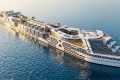
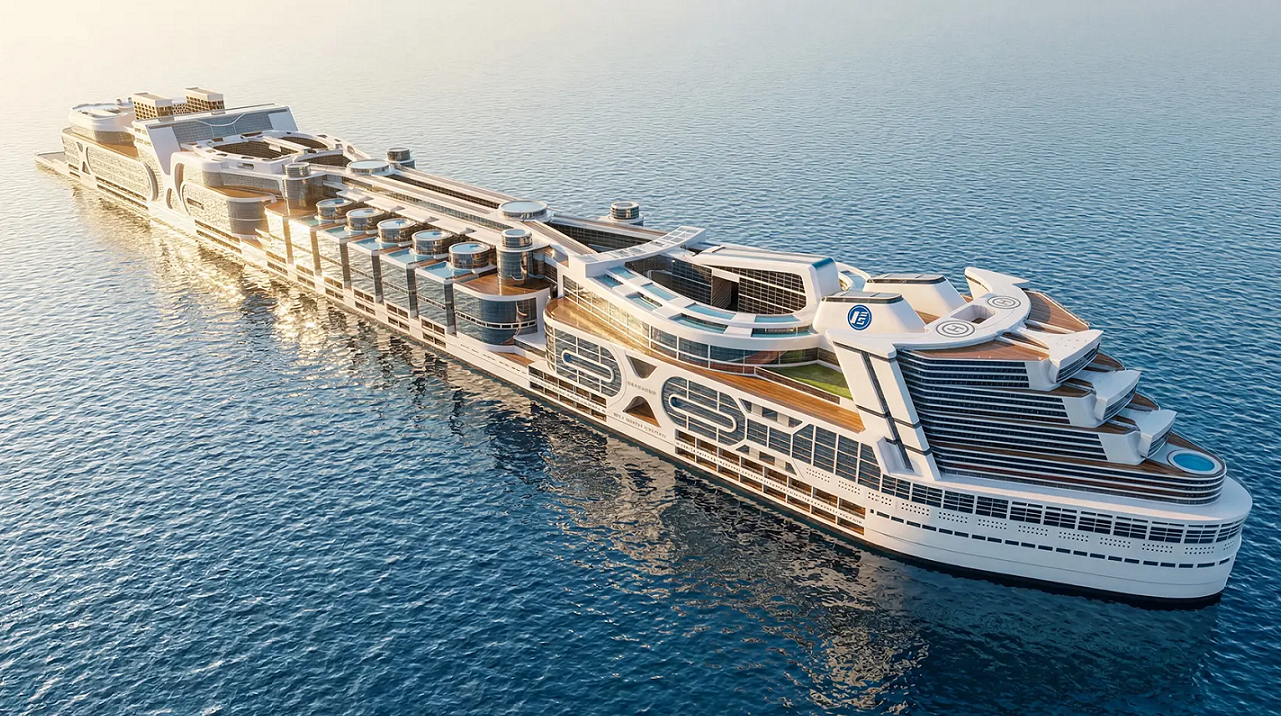
A project for a gigantic vessel designed by engineer Norman Nixon. It was not intended to be a fixed city at sea, but rather a massive floating ship – up to 1.8 kilometers long – that would continuously circumnavigate the globe.
It promised a home for 80,000 residents, complete with infrastructure and free from taxes, customs duties, or state interference. However, construction has yet to begin. Estimated costs have skyrocketed to an astronomical $20 billion.
Although the creators raised significant capital from initial investors, the project remains purely a concept on paper, serving as a lure for potential future backers.
MS Satoshi (2020)
This represents the most tangible crypto-libertarian experiment to date. The company Ocean Builders purchased an aging cruise ship, renamed it in honor of the creator of Bitcoin, and began auctioning off cabins as permanent residences for digital nomads and crypto-enthusiasts.
Transactions on board were to be conducted exclusively in cryptocurrencies, and the ship was intended to be anchored in international waters off the coast of Panama.
The project collapsed within just two months. The organizers ran headlong into a major obstacle in the form of maritime law: commercial insurance companies refused to provide coverage for a ship that did not use conventional currency.
Consequently, the vessel lost its certifications, and the Panamanian authorities prohibited it from operating.
The enormous daily operating costs quickly led to the vessel’s financial ruin.
Legal, Logistical, and Ideological Myths of „Floating Freedom“
Why are these seagoing projects fundamentally unworkable? The reason is not poor management, but a fundamental misunderstanding of the reality of maritime law, combined with an inability to address other fatal challenges.
The Fiction of a „Legal Vacuum“
The greatest misconception is the idea that international waters constitute a lawless zone. However, under the UN Convention on the Law of the Sea (UNCLOS), there is no such thing as a stateless ship. Every vessel must sail under the flag of an existing sovereign state (the „flag state“).
Consequently, the ship effectively becomes a floating territory of that state; its laws, regulations, and taxes apply in full on board.
If a ship were to lack a flag, it would be classified as a pirate vessel – subject to legal seizure and confiscation by any nation.
Absolute Dependence on the Mainland
A ship is not a closed ecosystem. It requires thousands of tons of fuel, potable water, food, medical supplies, and technical maintenance – services that can only be provided by land-based states. This necessitates regular calls at ports located in sovereign nations.
These sovereign states, however, retain the power to impose tariffs, conduct inspections, or simply deny the vessel entry at any time. Thus, a „floating society“ remains entirely at the mercy of land-based governments.
Technical and Financial Obstacles
Without international liability insurance, a ship will be denied entry to any port in the world. However, insurance companies and certification authorities are firmly integrated into the global financial and state system. Once they identify a venture as a risky political experiment, they will refuse to insure the vessel, effectively taking it out of operation immediately.
Lack of Protection
By declaring itself independent of states, a vessel also forfeits their military and legal protection. In international waters, it thus becomes an easy, defenseless target for pirates, organized crime, or the power interests of stronger nations.
The Paradox of Internal Tyranny
The greatest ideological paradox awaits libertarians right on board. Due to the practical realities of survival at sea, absolute autocracy prevails on any ship.
Maritime law grants the ship’s captain near-unlimited power – he may restrict personal freedom, confiscate property, or dictate the vessel’s course in the interest of safety.
By fleeing states and governments on the mainland, the ship’s inhabitants fall into the trap of an absolute, one-man dictatorship – one from which it is not so simple to escape while in the middle of the ocean.
Peddlers of Mere Illusions
The concept of a „free ship“ is, at its core, an expensive, dangerous, and unfeasible delusion. It serves as a warning to all sincere proponents of a free society: do not fall for the naive romanticism of an exile on the high seas.
One cannot shake the impression that behind these projects lie classic con artists – peddlers of pipe dreams – who exploit the natural human yearning for freedom to extract substantial sums from gullible investors, enticing them to purchase cabins in ventures that will either never set sail or collapse in short order.
The struggle for a freer society cannot be won with computer animations of a „free paradise“ – no matter how beautiful or utopian they may appear – let alone by the banal act of paying „indulgences“ into the pockets of false prophets of pseudo-freedom, who preach „eternal life“ aboard these floating utopias.