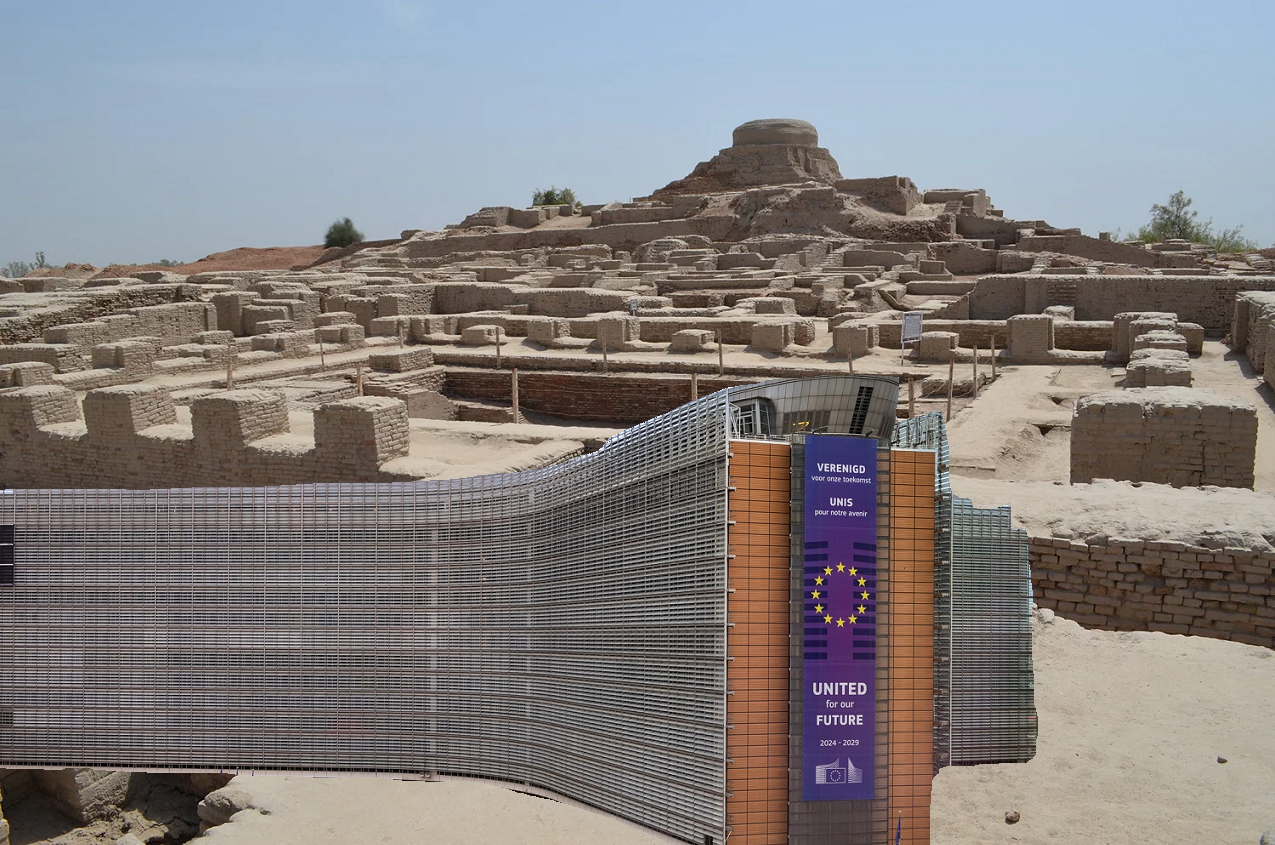
History refutes the necessity of the state: Stateless civilizations have successfully existed for centuries. (Illustrative photo: editorial collage).
History proves that a non-state or stateless society is both possible and real. Examples include the successful—though often obscured by state-run education systems—existence of the stateless Harappan civilization, the society based on the „tuath“ system in medieval Ireland, and stateless Pennsylvania in America at the turn of the 17th and 18th centuries.
We live in an era of total statism and the resulting „statist blindness.“ Modern humans are born into a world that has been carved up—down to the very last square centimeter—among sovereign states. Consequently, they have fallen for the illusion that, without the omnipresent hand of the government apparatus and an all-powerful state, humanity would instantly descend into bloody chaos.
Today, the state’s monopoly over our lives, our wallets, and the rules of the game is perceived as an immutable law of nature—as self-evident as gravity.
Recent attempts to establish free zones, engage in „seasteading,“ or create decentralized jurisdictions without political rulers have ended in failure—and, furthermore, have run headlong into a wall of ridicule. The academic mainstream and the media generally dismiss these endeavors as utopian curiosities, naive fantasies, or the eccentricities of avant-garde anarchists.
Yet, this pervasive skepticism is nothing more than a profound historical amnesia. It is as if humanity has forgotten—or rather, has been compelled to forget—that for centuries, civilizations flourished successfully without a single tax form being filed or a single government ministry in existence.
The historical facts are clear: the world was not always defined by statism. On the contrary, for relatively long periods, there existed highly developed, stable, and prosperous stateless societies. These civilizations empirically demonstrated that complex urbanism, science, a just legal system, and international trade could all function on the basis of voluntary cooperation—without the need for a central ruler or a standing army.
The following three historical examples, drawn from different eras and continents, demonstrate that a non-state society is not merely a theoretical fantasy of free-thinking philosophers, but a practice with an empirical basis. From ancient Asia and the European Middle Ages to the Americas of the modern era, people have lived in peace and prosperity, free from the domination of a state apparatus.
The Indus Valley Civilization: A Society Without Kings or Weapons (c. 2600–1900 BCE)
The Indus Valley Civilization—also known as the Harappan Civilization—presents one of the most fascinating puzzles for modern archaeologists and pro-statist historians alike.
Across an area exceeding one million square kilometers in what is now Pakistan and western India, a Bronze Age society flourished—one that, in terms of both scale and technological sophistication, fully rivaled ancient Egypt or Mesopotamia.
Unlike those civilizations, however, the Harappans created this vast urban environment without any trace of centralized state power.
When archaeologists uncovered monumental cities such as Harappa and Mohenjo-daro, they naturally expected to find the typical hallmarks of early states: grand palaces for rulers, temples glorifying god-kings, monumental tombs filled with gold and sacrificed subjects, or at the very least, massive reliefs celebrating military victories.
Yet, nothing of the sort was found. The architecture of the Indus cities was strictly utilitarian, focused on the well-being of the general population rather than the projection of „state“ power.
The most striking feature of this civilization was its extraordinary degree of standardization and voluntary coordination. The cities boasted a sophisticated grid-based street system, uniform fired bricks with precise dimensional ratios, and the most advanced sewage and water supply systems of the ancient world—surpassing even the achievements of later Roman engineers.
All of this functioned on the basis of decentralized trade and shared cultural norms. Material culture—the physical, tangible objects created and left behind by the people of this civilization—points to the existence of guilds and trade networks that managed infrastructure without the need for political dictates.
The absence of a state monopoly on the use of force in the Indus Valley is further evidenced by a complete lack of offensive weaponry or military infrastructure. Archaeological findings have revealed no standing armies, no fortifications designed for defense against neighboring cities within the civilization itself, and no skeletal remains bearing signs of mass violence or warfare.
Peace was not maintained through the threat of state-imposed punishment; rather, it was a natural outcome of mutually beneficial commercial cooperation and a high standard of living.
The Harappan experiment endured for seven centuries—a duration that most modern centralized states have not even come close to matching. Its collapse was not brought about by the internal disintegration of a political system or by civil war, but rather by dramatic climatic shifts, the drying up of the Sarasvati River, and changes in monsoon cycles.
Thus, the Indus Valley civilization stands as irrefutable proof that urbanism, science, international trade, and a high degree of standardization can flourish within a purely stateless society.
Early Medieval Ireland: Polycentric Legal Order in Practice (6th to 12th Centuries)
Early medieval Ireland is sometimes cited as the best historical model of a functioning anarcho-capitalism or polycentric legal system.
For more than half a millennium, until the Anglo-Norman invasion, Irish society did not know the institution of a central state, a single legislature, or a monopoly judiciary. Nevertheless, this was not a primitive tribal anarchy, but a highly sophisticated, literate and legally advanced Christian culture.
The basic socio-political unit in Ireland was the tuath. Around 150 of them existed in parallel throughout the island. However, the Tuath was not a state in the geographical sense; rather, it was a voluntary association of free landowners who decided for mutual defense and legal protection.
At the head was the king, whose powers, however, would shock a modern statist. The king had no legislative power, no monopoly on the judiciary, no compulsory taxes from the citizens, and could not force anyone to join the army.
Law in Ireland, known as Brehon Law, was fully decentralized and discovered, not dictated from above. Legal experts (brehoni) were private entrepreneurs whose livelihood depended on their reputation, wisdom and impartiality.
If two people entered into a dispute, they chose a brehon as an arbitrator. The Brehons had no state police available to enforce their judgments. The enforceability of the law was based on the strength of social consensus, the institution of guarantors and the threat of social ostracism or loss of honor, which in the society of that time usually meant economic death.
The entire Irish legal system was built on the principles of restitution (compensating the victim) and not retribution (punishment by the state). If a crime, including murder, was committed, the culprit or his family had to pay the victim or survivors a set compensation expressed in property (often cattle).
The state did not exist as a third party to the dispute, which would parasitize on the fines. Justice was strictly a private matter between the injured party and the aggressor, which minimized the escalation of violence and encouraged a quick reconciliation.
This polycentric system has demonstrated incredible stability and flexibility. He was able to absorb the introduction of Christianity as well as repeated Viking invasions without centralizing power in the hands of a single dictator.
Legal pluralism and the absence of a state in Ireland disappeared only under the pressure of the brutal external military power of the Kingdom of England, which over the centuries systematically and forcibly eradicated Brehon law to establish its own monopoly of power on the island.
Pennsylvania (1681–1756): A „Holy“ Libertarian Experiment on American Soil
Modern history offers an even more radical example of a stateless arrangement, which emerged right in the heart of North America.
When the English Quaker William Penn received a charter from King Charles II for the territory of present-day Pennsylvania, he decided to implement what he termed a „Holy Experiment.“
As a deeply religious pacifist and an opponent of state coercion, he applied radical religious, ethical, and political principles in the newly founded colony—principles that effectively eliminated the state apparatus.
For more than seventy years, Pennsylvania functioned as a thriving civilization of white settlers, despite lacking the fundamental instruments of state sovereignty. The colony had no official army, no mandatory militias, and no state taxes intended to fund a coercive apparatus. Furthermore, it had virtually no bureaucracy.
Public administration was kept to an absolute minimum, and most public services, infrastructure, and social welfare were organized through voluntary Quaker communities and the free market.
While neighboring colonies waged bloody wars of extermination against indigenous Native American tribes, Pennsylvania’s pacifism brought long-lasting peace to the region. William Penn and his followers consistently rejected the state-sanctioned expropriation of Native American land. Instead, they treated the indigenous people as equal partners and purchased all land from them legally—on a voluntary basis—through formal commercial agreements.
Paradoxically, the absence of a state army did not lead to vulnerability; rather, it eliminated the very source of tension and conflict.
This state of radical freedom sparked an unprecedented economic boom. Thousands of immigrants from across Europe flocked to Pennsylvania—and especially to its hub, Philadelphia—fleeing religious persecution, property confiscation, and compulsory military service in their home countries.
The absence of customs barriers, regulations, and taxes transformed the colony into one of the wealthiest and most productive places on the American continent, where crafts, agriculture, and culture flourished.
Pennsylvania’s libertarian experiment did not end due to internal collapse or economic crisis. Its conclusion in 1756 was forced by external geopolitical pressure during the Seven Years‘ War (the French and Indian War).
At that time, the British Crown compelled the Pennsylvania Quakers to submit to imperial policy, impose taxes, and establish a militia. Rather than violate their pacifist principles, the Quakers chose to resign en masse from their positions in the legislative assembly.
Nevertheless, seventy years of prosperity without a state left behind indelible proof that freedom and the absence of coercion are the driving forces of human progress.
A Way Out of the Statist Trap
Historical examples—the Indus Valley civilization, early medieval Ireland, and Quaker Pennsylvania—shatter a foundational myth of modern political philosophy: the idea that order, law, and prosperity are the natural products of a state monopoly.
These non-state societies were neither primitive tribes nor fleeting anomalies; they were complex, technologically advanced, and enduringly stable civilizations. They demonstrate that human cooperation is primary, whereas the state is a secondary, parasitic apparatus grafted onto pre-existing, functioning social structures.
The experiences of these three eras offer vital lessons for contemporary efforts to build freer enclaves and non-state communities.
Law can exist independently of the state. The model of medieval Ireland proves that law and justice can function as decentralized services within a free market.
Economic prosperity is the best defense. The Pennsylvania experiment shows that eliminating taxes and bureaucracy unleashes such a vast reservoir of human productivity that the region immediately becomes a magnet for capital and talent from across the globe.
Modern enclaves of freedom—such as special economic zones or autonomous cities—must leverage economic necessity: they must create conditions for innovation so compelling that the surrounding, heavily regulated world cannot simply turn a blind eye.
Infrastructure without coercion: The Harappan civilization refutes the argument that large cities and complex infrastructural networks require central planning. Voluntary standardization and cooperation among guilds can resolve even the most intricate logistical challenges.
In the 21st century, this role is being assumed by open-source technologies, the sharing economy, and peer-to-peer networks, which enable the coordination of millions of people without political dictates.
The past has demonstrated that society can exist without a state. The present provides us with technologies that make it possible to rebuild such a world on a global, digital scale. Thus, the state’s monopoly may not be the „end of history“ after all, but merely a temporary historical detour.