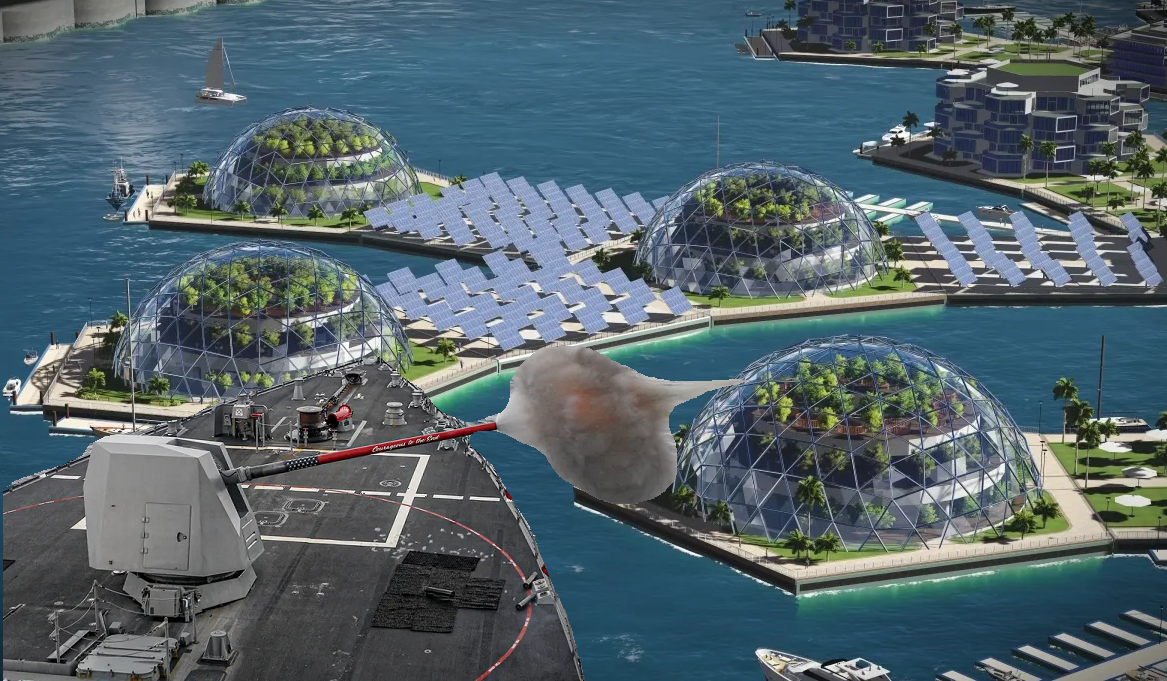
All global projects aimed at creating a free or stateless society are failing. (Illustrative photo: The "Floating Island" utopian project).
Projects and efforts to build non-state—or, more precisely, free—societies, which organizers have pursued in recent years, are failing completely. Every attempt to establish an alternative society capable of eliminating or reducing aggression and increasing individual freedom has ended in failure.
Projects such as Floating Islands, the Free State Project, Free Private Cities, and Liberland have proven futile in practice; they have failed to provide participants with anything that would bring them even a step closer to their envisioned dream of freedom—or, by extension, a free society.
Even where such projects have been formally launched, they remain at square one, with their participants still fully subject to the jurisdictions and regulations of traditional states.
Beyond this practical collapse, these initiatives also face total indifference from the general public and receive zero publicity outside of narrow libertarian circles. When each project is evaluated against an uncompromising criterion—whether it has definitively eliminated state aggression and increased the freedom of even a single individual or business—the actual result is clear: zero.
The illusion of Floating Islands and socialization in New Hampshire
The failed „Floating Islands“ project, spearheaded by the Seasteading Institute, serves as a cautionary tale regarding technological naivety. The initial, ambitious plan to construct autonomous floating platforms in the territorial waters of French Polynesia ended before it could even begin.
As soon as the local government faced political pressure and public backlash, it immediately rescinded the signed memorandum of understanding. The project does not exist in any physical form, demonstrating that relying on legal agreements with existing political apparatuses is a dead end for the cause of true freedom.
Within the continental United States, an attempt at systemic change proved equally fruitless. The „Free State Project“ in New Hampshire—which, since 2001, has encouraged thousands of libertarians to relocate en masse with the goal of gaining political control over one of the U.S. states—has yielded absolutely nothing in terms of genuine sovereignty.
Federal laws, regulations, and—most notably—tax pressure from the IRS apply there with the exact same relentless force as they do throughout the rest of the United States.
Ultimately, the entire initiative resulted in little more than the participants socializing with one another, organizing community festivals, and creating an isolated social bubble—one that failed to eliminate the standard state aggression directed toward the individual.

From grandiose promises to the courtroom
German entrepreneur Titus Gebel and his company, Tipolis, pinned high hopes—and a fair amount of publicity—on their „Free Private Cities“ project. However, the promised model—in which the state is replaced by a private operator that guarantees security and legal rights under an explicit contract for a fixed fee—has, in reality, left only a bitter aftertaste of unfulfilled plans.
Experience has shown that host states, within the framework of so-called Special Economic Zones, invariably retain sovereignty over criminal law, the military, and ultimate jurisdiction. The flagship of this movement, the Próspera zone on the Honduran island of Roatán, found itself in a state of total legal uncertainty following a ruling by the Honduran Supreme Court that such zones were unconstitutional.
Instead of establishing a space of freedom, the project is now mired in international arbitration cases involving billions of dollars. In early 2026, Gebel himself admitted that implementation was nowhere in sight.
He effectively transformed what was originally a „pro-freedom“ venture into standard corporate consulting for the establishment of conventional industrial zones—a model that offers individuals no protection from the state, let alone genuine freedom.
Other attempts, originally aimed at creating a free society, have likewise reached a dead end or simply faded into oblivion.
OVERVIEW OF FAILED “PRO-FREEDOM” PROJECTS:
Liberland:
An attempt to form a new state on the disputed territory of Gornja Siga, located between Croatia and Serbia, has run up against the uncompromising reality of police control. The territory is firmly under the authority of Croatian officials, and any attempts at physical settlement result in immediate arrest or expulsion. No individual or business can operate freely there.
Liberstad:
Presented as an autonomous city, this Norwegian project is, in reality, nothing more than the purchase of private land. The entire community remains fully subject to Norwegian building codes, local authorities, and the national tax system. Labeling a standard form of co-ownership a “stateless” society is merely a marketing ploy.
Atlas Island:
With its roots in the Caribbean, this project promises freedom in international waters and a system of “voting with ships”; in practice, however, it has amounted to little more than the commercial sale of expensive solar-powered catamarans. Participants are simply purchasing luxury recreational residences that remain subject to international maritime law and the jurisdictions of their home ports.
Montelibero:
A decentralized movement in Montenegro—where libertarians have been purchasing real estate with the goal of establishing a crypto-economic community—has collided with the harsh reality of state sovereignty. Montenegrin authorities and laws hold absolute and fully enforceable jurisdiction over this territory. Any attempt to conduct unregistered business or engage in construction without a permit is immediately suppressed by state power.
Los Proprietarios:
Although this Argentine project contractually prohibits its members from using state courts—under penalty of expulsion from the community—such a provision is invalid under official law. In the event of serious property disputes or criminal offenses, the Argentine justice system completely disregards the project’s internal rules and subjects the perpetrators to the standard state apparatus.
An African Utopia: The Latest Dead End
The Sherbro Island project in Sierra Leone is the latest addition to a long list of failures. Backed by investors and celebrities, this initiative promises to build an eco-friendly, economically autonomous „smart city“ on an island off the African coast.
From the outset, however, the entire concept remains fatally dependent on concessions granted by the central government in Freetown. Historical experience with African governments clearly demonstrates that any contractual sovereignty is illusory—vanishing the moment a political coup or regime change occurs.
Past attempts to establish a truly free or non-state society clearly show that this is a formidable undertaking. The primary and greatest obstacle is the total „etatization“ of the planet—both in a physical sense (there is no longer any unoccupied territory on Earth free from state power) and in a mental sense (most of humanity cannot even conceive of a world existing without state paternalism).
However, the failure cannot be blamed solely on external pressures. Questions also arise as to whether the chosen concepts, strategies, and organizational structures of the “pro-freedom” projects themselves were tactically sound and sufficiently inventive.
A separate issue concerns the credibility of certain initiatives and the true objectives of projects that their organizers outwardly “market” as being “pro-freedom”…